
Data-driven Report Became Advocacy Tool

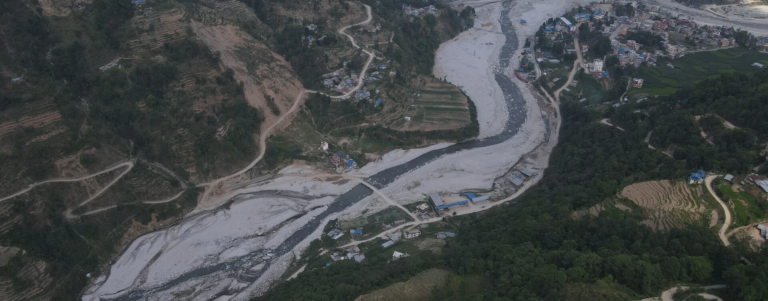
Post flood image of Melamchi river flowing through mountains and settlements / Credit: Saligram Dulal.
On June 15, 2021, floods devastated businesses, settlements, agricultural land and much more in a deadly flash flood event in Nepal. The disaster caused a total economic loss of approximately US$436 million in Melamchi municipality and US$62 million in Helambu rural municipality.
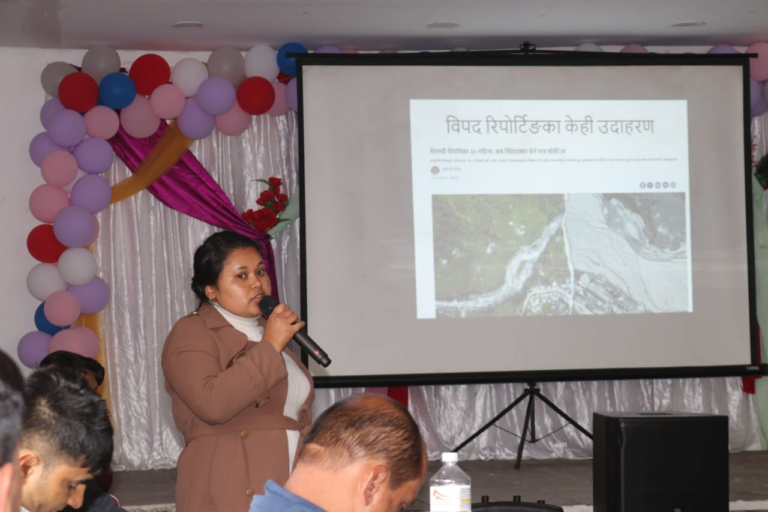
Journalist Bhagirathi Pandit, who hails from the flood-affected region, was one of 15 journalists who attended a media training workshop on using data and GIS tools to report on climate impacts in June 2024, led by the Centre for Data Journalism Nepal (CDJN), a not-for-profit media development organization. CDJN, a media grantee of EJN, supported her story idea.
“I wanted to explore the impact on communities’ livelihoods given the delayed government response, and to take a closer look into the initiatives the government has since taken for reconstruction,” Pandit shared with EJN in February 2025.
“My mentors suggested that the damage caused to medium-sized businesses could be shown [along with data]. This is my first data story; now it has become very easy for me to work with data,” she added.
Pandit spent months on her story, which was published in Nepali in February 2024 by Ukaalo. She reported that the flood-affected communities in Helambu and Melamchi municipalities had raised their concerns to the local government for the past 30 months or so, but were still waiting for a response.
Her data story highlighted the physical damage at length: 720 houses, 393 businesses, 11 trout fish farms, 11 motorized bridges, 10 suspension bridges and about 4 kilometers of paved roads were destroyed. Dozens of irrigation canals, rice grinding mills and water tanks were also damaged. Pandit used satellite imagery sourced from Google Earth Pro, comparing images before and after the 2021 floods, to depict the scale of the loss and damage.
Budgets and programs released by the government at federal (central) provincial (seven in total), and local (including, municipalities and rural municipalities) levels since then contained only vague declarations and no plans to revive the businesses devastated by the disaster, such as the fish farms or buffalo farms.
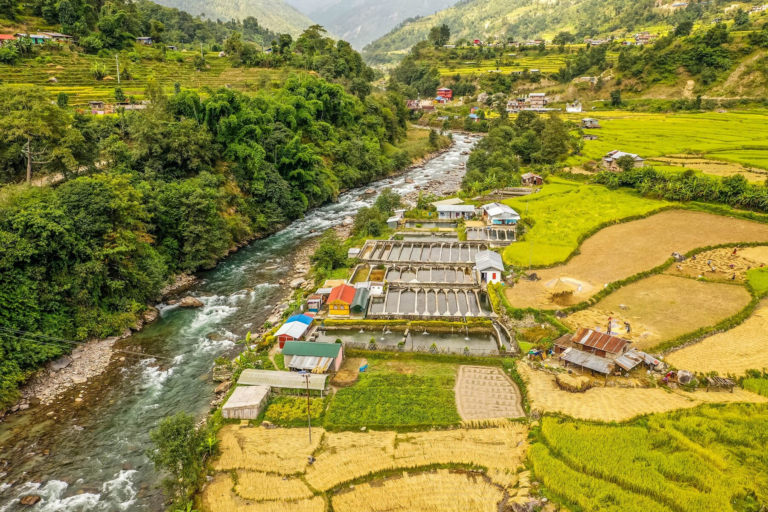
Three trout farms (Sindhu, Langtang and Jayabageshwari) before the flood, just below the Red Bridge in Chanaute / Credit: Helambu Rural Municipality Facebook Page.
The support from EJN and CDJN gave Pandit the time and tools needed to pursue an in-depth data journalism story, reporting from the flood-affected sites. She felt she could ask the right questions of survivors with empathy because, as a local, she understood the struggles of her own people.
“This fellowship helped me develop my skills and allowed me to visit the field several times,” said Pandit, who noted that in Nepal, environmental coverage did not typically go into too much detail. “Journalists don’t go deeper into remote areas to cover such local issues,” she added.
Her story garnered significant attention. It was republished as a cover story in the locally recognized Nepali magazine, Sindhu Yatra Monthly. Committees in the flood-affected districts said Pandit’s in-depth media coverage motivated them to mobilize further. Her story helped them clarify both their plight—and their funding needs—in subsequent petitions to the Nepal government, they shared.
According to CDJN’s Arun Karki, it highlighted the power of journalism to “drive local action, raise awareness and stimulate conversation on climate change issues at both local and national levels.”
Flood-affected victim communities left in despair
Soon after the floods in 2021, two flood-affected victim committees, one from Helambu and other from Melamchi had formed to demand an integrated plan for safer houses, livelihoods and grants to rebuild businesses, as they sought to rehabilitate settlements still at risk along the river. They wanted a comprehensive damage assessment and an integrated plan for post-flood reconstruction instead of piecemeal plans from various ministries of the federal government, shared the journalist. Those, she said, had allocated funds for road and bridge construction and river channeling, but little else.
Hasta Bahadur Pandit (no relation to the journalist), a member of the flood-affected victim committee from Helambu, lost property and goods worth around NPR 10 crore (≈ US$713630) in the 2021 floods, and is one of the campaigners behind these efforts.
“This story was special as it was reported in detail and presented a very local viewpoint of flood-affected victims who’ve been reeling with the failure of the government to reconstruct the area,” Hasta told EJN in February 2025. He said that Pandit’s story made people become more engaged in the struggle to demand support.
“After [Pandit’s] story got published, the feelings of the flood victims were sparked and they used the story as the basis to ask for [comprehensive] reconstruction of the areas” he said.
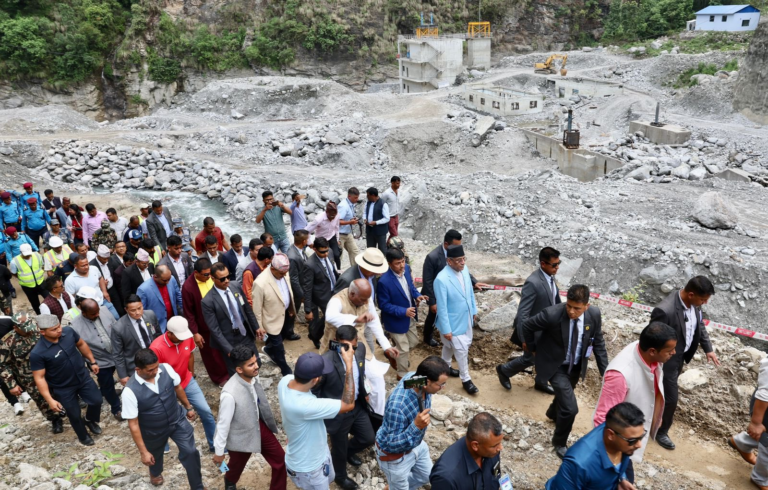
Melamchi flood-affected site visit by ministers / Credit: Salilgram Dulal.
In 2023, a local NGO in Nepal, Prakriti Resources Centre (PRC), produced a financial assessment report on Melamchi 2021 floods’ loss and damage in collaboration with the Stockholm Environment Institute (SEI). The study found that a majority of households received government financial support ranging from US$76 to US$380, with a few, who lost everything, including their homes, receiving between US$2,280 and US$3,800.
The majority of their survey respondents (88%) expressed dissatisfaction with the support, considering it insufficient to compensate for their losses and damages.
“Even though the government paid a compensation amount of about NPR 3 Lakh (~US$2,150) to affected people, soon after the floods; that wasn’t enough for them to rebuild their lives,” Hasta explained to EJN.
It did not cover costs to reconstruct homes and businesses, relocate to a less vulnerable area or receive training for alternative livelihoods, he said.
Pandit quoted experts from the Disaster Studies Center at the Institute of Engineering Studies (Pulchowk Engineering Campus) in Nepal, who emphasized the need for a more organized approach to strengthening resilience and reconstruction after major disasters—instead of replacing bridges and roads prone to future floods, and disbursing traditional cash grants, which left people still vulnerable in flood-prone areas.
Bhagirathi Pandit sharing her EJN-supported story at a program event organized by an NGO, Practical Action Nepal, on landslide and early warning system in Nepal / Credit: Kiran Thapa.
Story sparked conversation among policymakers: government agreed to fulfil flood victims’ demands
Balkrishan Deuja, a local politician from Melamchi, lost his land, fish farm, rice and flour mill in the 2021 floods and since then he has actively been trying to persuade the government to proffer financial support to devastated businesses in the area.
When Pandit’s story was published, Deuja used her story to reach out to various ministers and political leaders from the province to the water ministry. “The story helped people realize [the whole picture]. Everything depends on detail and facts. This story also centered people’s voices and people’s spirits,” he said.
“Bhagirathi’s story helped to influence political persons like the mayor, vice mayor, ward chair persons, political party leaders and ministers and also parliament members. We pushed them again to allocate the budget for flood victims,” Deuja told EJN.
“I urged the former minister Sher Bahadur Tamang, mayor and vice mayor of Melamchi Municipality and also ward chairpersons to read Bhagirathi’s story,” he added.
Bhagirathi Pandit then attended an event with Balkrishan Deuja on July 4, 2024, which was attended by Ganga Lal Tuladhar, a former member of parliament (MP) who served as a minister of Education, Science & Technology and Local Development and was also a member of National Disaster Risk Reduction and Management Council in Nepal. He, too, was advised by Deuja to read her story to gain a better understanding of the situation.
As part of the flood victim committees’ efforts to lobby different local government offices, they also met with Pradeep Yadav, the minister for water supply and sanitation at the time, on September 30, 2024. He heard their demands, signed a 10-point agreement and set up a high-level steering committee to implement it. This impact investigator reached out to Yadav multiple times for comment but was unable to secure an interview.
As the Melamchi municipality supplies more than 30% of Kathmandu’s drinking water, Yadav agreed to submit a proposal to the council of ministers to allocate 25% of the royalties received from the Kathmandu valley to ensure the welfare of the residents of Melamchi watershed. This would help fund the development of local schools, hospitals and roads, embankments along the river banks to protect the remaining land and villages from future floods, as well as additional compensation for flood-affected families.
The committees were led to believe that the next national budget, slated to be announced in June-July 2025, would allocate the funds needed to address these long-standing concerns.
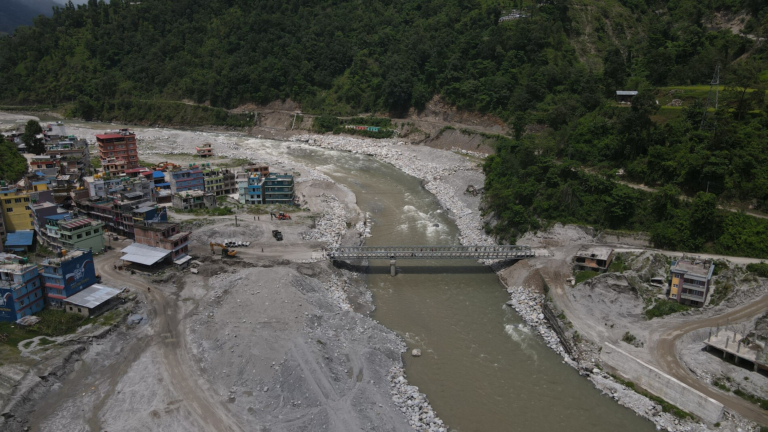
New bridge being constructed at Melamchi bazaar / Credit: Salilgram Dulal.
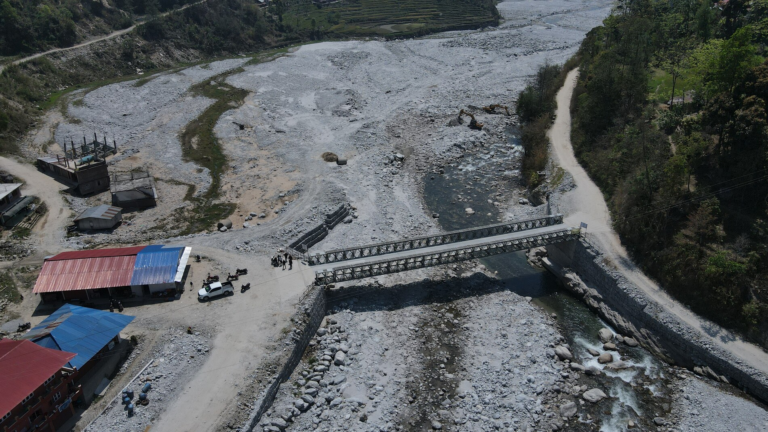
New bridge being constructed at Helambu / Credit: Salilgram Dulal.
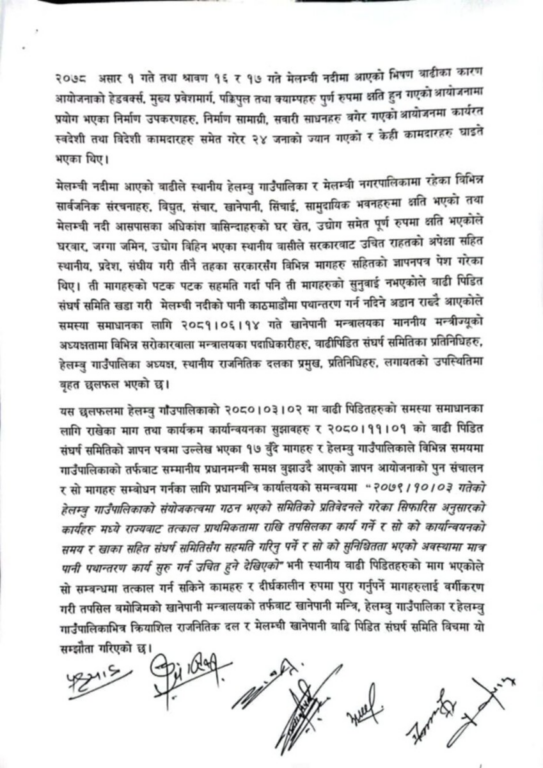
The 10-point agreement signed by Pradeep Yadav of the water ministry and the flood victim committee in Nepali / Credit: Bhagirathi Pandit.
View the full 10-point agreement.
In reality: the wait continues
Although the story helped affected communities argue their case, the resulting 10-point agreement and the 2025 budget did not deliver as promised.
“There is no program included specifically for the affected people. But to ensure the continuation of the Melamchi drinking water project to supply Kathmandu valley, a budget of 269 million Nepali rupees was allocated for the construction of Melamchi Ambathan road and bridge,” the journalist explained.
Aaitaman Tamang, the current mayor of Melamchi municipality, told EJN in October 2025 that “leaders make big promises when they visit affected areas but it hasn’t been their priority while allocating budgets”. “The ten-point agreement signed by the stakeholders and the ministry of water supply hasn’t been implemented at all,” he said.
“There are some scattered budgets allocated by the federal and provincial government but there is [still] no integrated rehabilitation and rebuilding plan in place. We have been promised many times by several governments formed in the last three years but none have come up with a concrete plan. We are not hopeful at all,” said Tamang.
Hasta, too, expressed disappointment. “The government needs to rebuild the areas that were affected by floods and safeguard the resilience of vulnerable communities on the river’s banks, especially considering the areas are frequently affected by environmental disasters like earthquakes, landslides and floods,” he said.
“There’s an urgent need for more journalists to report on these issues at a ground level especially in consultation with the local people affected so the stories are impactful and reach decisionmakers for policy change,” he added.
Pandit agreed. “In general, politicians and Nepali people are not aware of the grave impacts of environmental disasters. And thus, they don’t care and exhibit lax behavior in implementing policies or allocating funds for flood victims, even after years,” she said.
She, too, reiterated that more consistent environmental reporting, especially in disaster-prone areas of Nepal, will help hold governments accountable. Media attention could help “ensure that the government strengthens not just its disaster response and resilience plans, but accelerates its actions too”, she shared.
For her part, Pandit continues to report on stories from the Melamchi area. “I now work as an independent journalist. After the fellowship, I gained the confidence to do in-depth investigative stories, and work on more stories from a data angle.”
This impact investigation report of EJN Grantee is published in https://earthjournalism.net/what-we-do/project-updates/in-nepal-ejn-grantees-data-driven-report-on-flood-impacts-supported