
Community Forests: Seeking Opportunities in Challenges

Achham / Ratna Rimal of Dhakari Rural Municipality-2, Achham, is the first female chairperson of the Kalika Community Forest Users Group. For her, establishing female leadership has become a major challenge. Although the Community Forestry Guidelines-2023 (2081 BS) emphasize women’s participation and leadership, a female chairperson has to face numerous challenges in a traditional, male-dominated hill society like Achham.
While Kalika Community Forest’s efforts to bring women into leadership for sustainable forest management and the conservation of local resources are considered commendable, Chairperson Rimal faces social, administrative and technical problems on a daily basis that seem difficult to resolve.
When she became the chairperson of this forest users group in 2022 (2080 BS), the operational plan had not been renewed for seven years. Rimal shares that while people used to jostle for leadership in the past, she stepped forward to become the chairperson herself after noticing that everyone started backing away later on.
“After becoming the chairperson, I managed to renew it with great effort, but I haven’t felt the community supporting forest conservation like they used to,” she says. “Instead, I hear remarks like, ‘Can work move forward with a woman in leadership?'”
When meetings are held under her leadership, some male members arrive late, others make excuses to stay absent and there are delays in implementing decisions. Formulating the community forest’s operational plan, renewing the institution and preparing annual reports are the responsibilities of the chairperson. Her experience shows that performing these tasks has been difficult due to the lack of expected cooperation from the community or the group.
Questions Over the Utilization of Community Forests
Karna Bahadur Budha, 57, of Dhakari-6, Dhungachalna, is a community forest activist. Active in community forest conservation and user welfare since his youth, he is currently the joint secretary of the Madhuban Community Forest Users Group. He became an executive official after serving as a member for 10 years.
Madhuban, which has 281 users, is denser now compared to the past. Yet, Budha is not happy. According to him, “12 to 15 years ago, everyone was eager to sit in the user group; in some places, elections were even held. Now, there are no people left in the village and nobody cares about the forest.”
“The forest has grown now not because of conservation, but because there are no people left to utilize it,” he says. “Right now, grass is going to waste in the forest and timber and firewood are rotting. Villagers migrated down to the Terai and there is no one left to rear livestock either.”
However, he assesses that the forest user groups did well in the past. “Since forest user groups were required to be inclusive, many women, Dalits and people with disabilities got opportunities and developed their capacities,” Budha says. “At that time, various organizations used to conduct trainings, seminars, tours, etc. Now, everything has stopped. The community’s sense of ownership over the community forest is declining.”
Stating that migration has heavily impacted community forestry, he added, “When there are no users left in the village, the relevance of the forest also diminishes.”
To make matters worse, the group where he serves as an official is no longer in a position to pay the forest watcher a monthly cash salary. “Since the forest has no source of income to pay wages, we collect grain from every household during the winter and monsoon seasons to give to the watcher.”
Fear of Wildlife in the Village
As local interest and monitoring regarding forest utilization decline, wildlife activity has increased in the community forest areas. Animals like wild boars, leopards and tigers have started entering human settlements. Farmers have become terrified following an increase in attacks on animal sheds.
Two years ago, Dila Devi Bayak, 29, of Turmakhand Rural Municipality-3, Bhairavsthan, died following an attack by a wild boar. She was attacked by the wild boar while returning home from her farmland and succumbed during treatment. Her husband, Bal Bahadur Bayak, says, “As wild animals have increased along with the forest, neither crops nor lives are safe anymore.”
Last January, Sushmita Dhami, 18, of Sanfebagar Municipality-11, Devistan, was injured by a wild boar when she went to the nearby Ghusulle Community Forest to graze goats. “In the jungle near the village where we always used to go, a wild boar chased and bit me severely. There is a menace of wild animals now in places where we used to grow crops before,” says Sushmita, who recovered after undergoing lengthy treatment at Bayalpata Hospital.
Prior to that, last May, Dharma Singh Thapa, 48, of Mohanyal Rural Municipality-1, Phalibisauna, Kailali, was injured in a tiger attack while visiting his ancestral home and in-laws in Dhakari, Achham.
Before that, in May 2024 (Jeth 2081 BS), Dhulu Sunar, 61, of Sanfebagar Municipality-13, Babla, narrowly survived a bear attack. Sunar, who was mauled by a bear in the Godakhola Community Forest while heading towards Ola village, still bears deep scars on his face. Sher Bahadur Shahi, 38, of Kamalbazer-6, Gairitad, fell victim to a tiger attack during the same week. Shahi, who was attacked while grazing goats in the Panchuli Community Forest, sustained injuries to his right cheek and leg.
Satya Raj Timilsina, the Ward Chairman of Kamalbazar Municipality-5, states that instances of wild animals destroying crops and attacking livestock and humans have been rising recently. He mentioned that after establishing community forests but failing to utilize them properly, the community itself has had to suffer.
There is a legal provision to grant compensation if a farmer goes to the Division Forest Office with a recommendation verified by the municipality’s agriculture branch, along with photographs of the crops destroyed by wildlife and a photocopy of the land ownership certificate. “However, even after fulfilling the entire process, farmers are only given a hard time citing various reasons,” the Ward Chairman says.
According to data from the District Police Office, Achham, one person died and 27 others were injured in wild animal attacks in Achham over the last two fiscal years.
Due to migration, the population in the hilly areas is decreasing while forests are expanding. The wildlife population has grown along with the forest. Padam Bohara, the Mayor of Mangalsen Municipality, states that predatory animals, including leopards, have started entering villages and settlements.
“In search of convenience, migration from the hills to the Terai increased and the youth went abroad,” he says. “As a result, forest utilization naturally decreased and the menace of predatory animals has risen.”
Therefore, Mayor Bohara claimed that they are working to stop migration by increasing investment in education and health. “We are creating an environment for share investment in productive projects and formulating income-generating plans through cooperatives,” he said. “We are also trying to arrange insurance to encourage the cultivation of fruits, vegetables, herbs, cereal crops, or animal husbandry based on soil testing results.”
Federation of Community Forestry Users Attempting a Revival
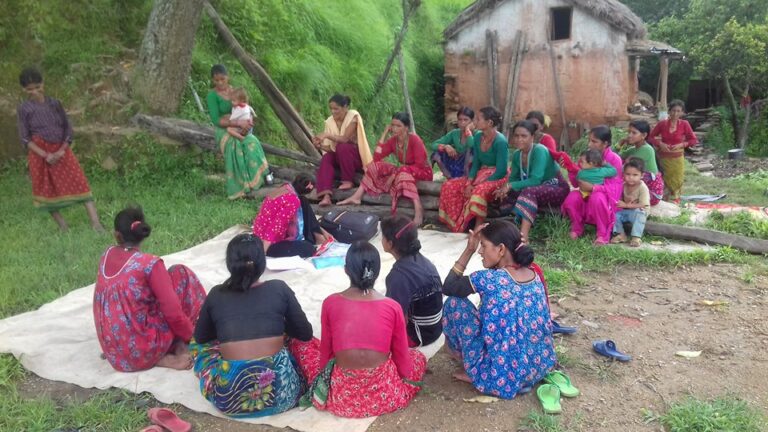
Women from Thuwa village in Achham waiting for a meeting of the Community Forest Users Committee. Photo: Menuka Dhungana
The role of the Federation of Community Forestry Users Nepal (FECOFUN) is considered crucial in the conservation and management of community forests. The Federation, which has been shoulder-to-shoulder in responsibilities like forest monitoring, forest fire control and safety, preventing illegal logging, wildlife management and ensuring community safety, has slowed down since the COVID-19 pandemic.
Radhika Bhujel, the District President of the Federation, states that efforts have begun to move forward with all stalled activities. According to her, monitoring of the forest sector has weakened not only because support from national-international organizations and local levels has fallen short, but also because the user groups themselves have become inactive.
“Trainings, observation tours and awareness programs are necessary to activate the office bearers and members of community forests,” says President Bhujel. “For this, the Federation, community, local levels and government agencies must work in coordination. Only then will forest conservation and safety, alongside wildlife management, be possible.”
According to her, user group members were previously active in regular meetings, implementing operational plans, inspecting forest areas and controlling forest fires. This ensured the sustainability of the forest sector, prevented illegal tree felling and kept a check on wildlife activities.
“However, managing community forests has now become challenging due to low activeness among group members, resource constraints and a lack of support from local levels,” says President Bhujel.
She mentioned that while the Federation is trying to formulate and implement plans, problems arise due to a lack of participation from members and fewer people remaining in the villages. “As a result, forest monitoring has decreased and control over illegal logging and grazing has weakened,” she said. “In interactions regarding community forestry, there is a problem of non-participation because there are fewer people in the community.”
Nevertheless, President Bhujel stated that the Federation is committed to increasing collaboration with local levels, activating user groups, running training or tour programs and establishing the relevance of community forests. “For this, cooperation between the community, administration and the Federation is indispensable,” she said.
Low Rate of Renewal of Community Forest Operational Plans
There are 423 community forests in Achham. Among these, only about 300 have renewed their operational plans, according to Ganesh Thagunna, the Information Officer at the Division Forest Office, Achham.
According to him, local communities in Achham have taken over the management of 46,341.41 hectares of forest area so far and 65,546 households are associated with community forest user groups.
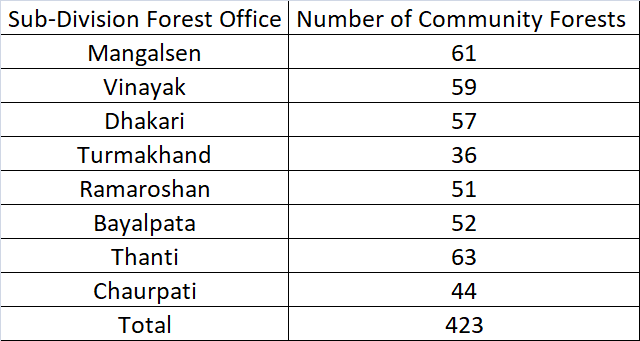
Community Forests under Various Sub-Division Forest Offices in Achham District
According to Division Forest Information Officer Ganesh Thagunna, apart from those failing to renew operational plans, there are also many groups that do not submit annual reports and audit reports on time. “This problem exists especially in forests that do not generate forest products,” he says. “On the other hand, groups that have forest products see timely completion of tasks ranging from acquiring PAN numbers and conducting audits to holding public hearings.”
Thagunna mentioned that several community and leasehold forest user groups have been demanding training related to herb collection, cultivation expansion, processing and marketing. Stating that users need skill-based and income-generating training as well as study tours, he said, “Along with women-focused leadership development training, information regarding climate change and biodiversity conservation and management has also become necessary.”
Creating Opportunities Through Collaboration
In the management of community forests in Achham district, challenges like delays in operational plans, user inactivity and rising wildlife activities are currently evident. Ratna Rimal, Chairperson of the Kalika Community Forest Users Group, believes that these challenges can be turned into opportunities by developing women’s leadership capacities, empowering the community and ensuring good cooperation between the local government and the Federation of Community Forestry Users.
Similarly, Radhika Bhujel, the District President of the Federation, mentions that sustainable forest management challenges can be transformed into opportunities by taking steps to increase herb-based entrepreneurship and income in community forests.
She believes that if there is good cooperation with the local levels and the Federation, the implementation of operational plans will be effective. “If training, tours and awareness programs are brought forward rapidly, the user groups will become active immediately,” she says. “After that, forest monitoring and conservation will grow stronger and it won’t take long for community safety and economic empowerment to follow.”
On the other hand, Mayor Bohara of Mangalsen states that the community can be retained in the villages by promoting productive businesses and increasing investment in agriculture and animal husbandry. “If we can inspire those who have the zeal to work to stay in the village, the terror of wild animals will also decrease and the sustainability of the forest will be ensured,” he says. “We must seek opportunities amidst challenges.”
(This report was produced with the support of the Internews Earth Journalism Network.)