Development plans should be made by the community: Peter Westoby

Kathmandu / Australian professor and community development expert Peter Westoby has said that development plans and solutions should not be imposed on communities from outside, but should be determined based on local needs, experience, and knowledge.
He said that the tendency to view communities as passive beneficiaries in the development process should be ended and they should be established in the role of leading decision-making and change, from planning to implementation.
Speaking at a one-day event titled ‘Learning from Nepal: A Gathering for People-Led Development’ held in Kathmandu on Tuesday, Westoby said that individuals, organizations, and development partners working in communities should practice listening to local people and trusting their knowledge and experience.
“It matters who we are asking questions to. It is equally important whether we trust the community or not. The community understands its own problems and realities. Therefore, development must begin with the community,” he said.
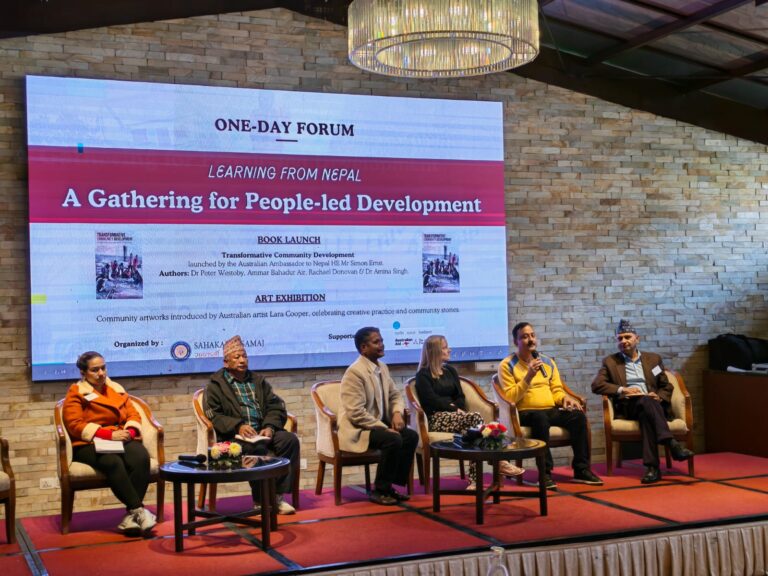
At the event, organized by the Society of Collaborators with the support of Australian Aid, The Asia Foundation’s Local Government Empowerment Program, Westoby presented his experiences on community-based development, the importance of dialogue, local knowledge, and participatory learning.
He explained the tendency for governments, NGOs, and international development partners to determine and implement solutions for communities themselves as a continuation of colonial and neo-colonial thinking.
He said that while development partners may have their own philosophies, research, experiences, and successful practices, there is no guarantee that all of these will align with the needs and priorities of the relevant community.
“It is a mistake to enter a community with your own solutions, philosophy, best practices or research and assume that is what they need. Development must start with the people,” he said.
In this context, he also recounted an incident related to Brazilian educationist and philosopher Paulo Freire. According to him, an English-speaking person had visited the house of a Portuguese-speaking Freire and tried to converse in English. However, after Freire had conversed in Portuguese for about 20 minutes, the person realized that it was his mistake to try to speak in English without respecting the other language.
Westoby said that language should not be understood only as a means of communication. He said that since language is linked to the culture, identity and self-esteem of a community, development workers working in any community should respect the language and culture of that community.
He praised the practice of the peer society of selecting people from the local community as community facilitators and teachers. He said that it makes sense to mobilize people from the local Tharu community in particular because they understand their language and culture.
“To respect the spirit of a culture, one must understand its language. Development workers who do not have deep respect for local languages and cultures may be perpetuating the colonial process without even realizing it,” he said.
Dialogue and Collective Learning in Freire’s Thought
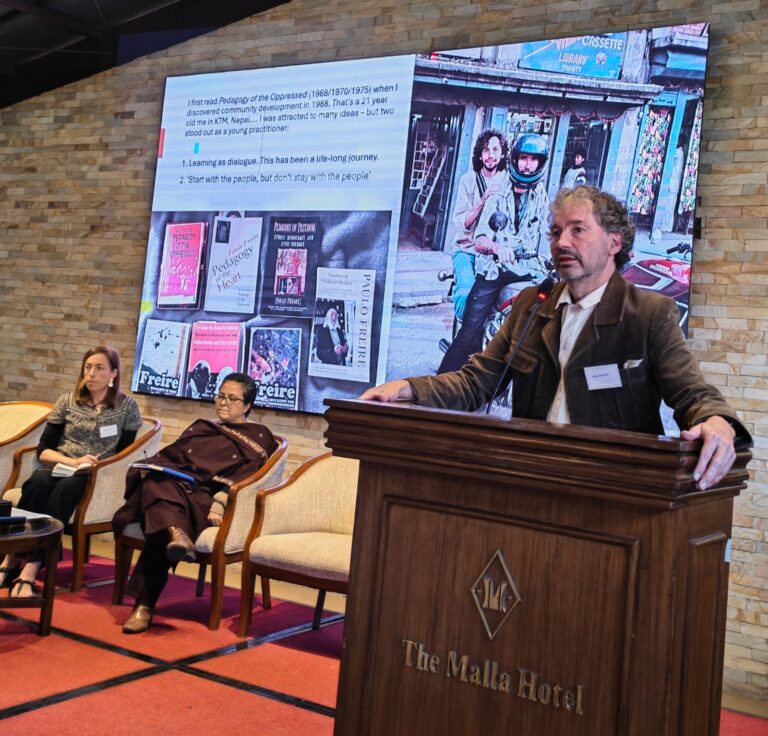
Westoby also discussed the impact of Paulo Freire’s famous book ‘Pedagogy of the Oppressed’ on his professional and academic life.
Recalling reading the book when he first came to Kathmandu in 1988, he said that since then he has considered dialogue as the basis of learning.
According to him, dialogue is not just a process of one side telling the other its views. It involves a willingness to listen to others, accept criticism, reconsider one’s own views, and change one’s mind if necessary.
He also recounted the incident in which American black intellectual and writer Bell Hooks criticized Freire’s book for not adequately including women’s perspectives.
While accepting Hooks’ criticism, Freire acknowledged that the book used male-centric language and that it needed to be improved. Westoby presented this incident as an example of real dialogue.
“A person who thinks they alone know the truth and is not willing to change their perspective is not in a real dialogue. Dialogue is a process of collective thinking. It prepares us to change our perceptions and question established beliefs,” he said.
He suggests that development workers should not present themselves as experts who know everything when they enter the community. He said that Freire’s idea that ‘my expertise is not to consider myself an expert’ is particularly meaningful to him.
Literacy is not only for employment, but also for rights.
Discussing Freire’s concept of popular education, Westoby said that literacy should not be limited to a means of obtaining employment.
To this end, he presented an example of a practice pioneered by the Highlander Institute and community activist Miles Horton in the US.
Citizenship schools were established there to teach English to African-American citizens. However, the purpose of these schools was not limited to providing linguistic knowledge. They also aimed to make people aware of language, civil rights, and participation, as people who did not speak English were often denied the right to vote.
In those schools, legal documents related to human rights were also used as language teaching materials, he said, thus linking literacy and civil rights.
He argues that education should not only enable people to obtain employment within the capitalist system, but also to understand their rights, claim them, and raise their voices in favor of those rights.
He said that the process of organizing the community and teaching are complementary to each other. Stating that organizing the community alone is not enough, he noted that real learning is possible only through reviewing and discussing the experiences gained in the process.
“I don’t just care how many years of experience a person has. What matters is how much they review and reflect on their experience. We learn not only from experience, but by reviewing experience,” he said.
He also said that the peer society combines Freire’s learning and review methodology with the practice of community mobilization and organization building.
Three Different Practices of Community Development
Westoby noted that there are three major types of practices in the field of community development around the world.
The first is the practice of social guidance. In this, the government, NGOs and development partners themselves determine the appropriate solutions for the community and try to move the community in that direction. He linked such practices to colonial and neo-colonial thinking, saying that most international donor agencies are still investing in this nature of development practices.
The second is the practice of community organizing, which prioritizes organizing people in a community, building collective power, and collectively advancing their issues.
The third is the practice of social learning. In this method, influenced by the ideas of Paulo Freire, communities review their work, activities, and experiences. They collectively reflect on what they learned, what needs to change, and how to move forward in the future.
Westoby explained the practice of social learning as ‘Living, Learning, Circles’, linking it to his experiences in South Africa.
He said that development should be connected to the real lives of people and they should have the opportunity to continuously learn from their own experiences. For that, he said, an environment of collective dialogue and discussion is necessary.
Noting that the participants of the program were seated in a circle rather than in a line, he said that such seating would facilitate mutual communication and collective learning.
“In a program discussing Freire’s philosophy, how can people communicate by sitting in a circle? When people sit in a circle, they communicate with each other and learn collectively,” he said.
He concluded that the purpose of development should not be limited to completing projects or conducting routine activities. Rather, he said that the core purpose of community development should be to enable people to think, learn, question, and become active participants in the process of change.