
Undermined Leadership: How State Policy Is Breaking Women’s Role in Community Forestry

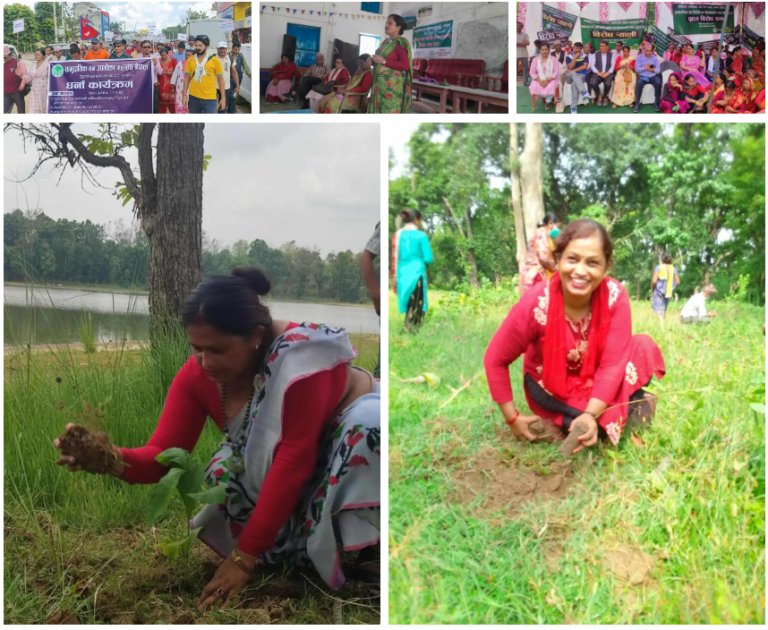
Dhangadhi/ Until a few years ago, Nirmala Bista of Amarbasti, Punarbas Municipality-11, Kanchanpur, had a world limited to her home, kitchen, and garden. She could barely speak in front of men even at small village gatherings, let alone attend public events.
If someone handed her a microphone, her throat would dry up, her palms would get cold, and her heart would race. She would not even be able to find the words to introduce herself. But now, Nirmala says confidently, “Nowadays, I can even sit down and talk to the Prime Minister.”
This change in Nirmala is not the result of any major political training or formal university education. It is the flower of confidence that has blossomed in the soil of the ‘Amar Gokul Community Forest’, which she has irrigated with her blood and sweat for the past few years.
This is the gift of that school, where she learned the ropes of leadership, management, and self-respect under the shade of green trees. Nirmala is one of thousands of women in the Far West Province whose self-confidence has been strengthened by community forests.
In this region, the concept of community forests has not only become a source of conservation and livelihood, but also an effective school of leadership development, capacity building and empowerment for women, Dalits and marginalized communities. This successful model, which Nepal can be proud of before the world, has strengthened the foundation of democracy in the villages and even averted a leadership drought.
Ironically, this successful campaign has recently been falling victim to the state’s impractical policies, the burden of double and triple taxation, and legal ambiguity. The green forest that produces gold is now in danger of being deserted due to the drought of government policies. This has caused concern among everyone from consumers involved in conservation to public representatives at the policy-making level.
A dream that grew in a desolate riverbed
Bhagatpur, Kailari Rural Municipality-6, Kailali was a desolate riverbed in around 2060 BS. There was a fear that the floods of the Mohana River would wash away everything during the rainy season, and that the dust from the wasteland would bury houses and farmlands in the winter. One of the few local women who had a small dream of collective effort in that desolate land was 22-year-old Jhuma Chaudhary.
Her life, which was limited to housework and childcare, then took such a turn that today she is leading thousands of users as the president of the Community Forest Users Federation of the Far Western Province.
“At that time, the cattle were in great need of grass and firewood,” she recalls, “and we, women alone, started working together to see if we could produce grass and firewood in the riverbanks.”
In the society of that time, it was a challenge in itself to organize such a campaign by women alone. It was as much an obstacle as it was a necessity.
Facing all kinds of obstacles, they formed the ‘Kanchan Women’s Community Forest’, with Damuli Chaudhary as the president and Jhuma Chaudhary as the vice president. They fenced off that small patch of land of about two and a half hectares and started planting trees. They set about building a nursery, raising and planting seedlings. They bravely protected the seedlings even during floods.
An organization helped them with fencing. All the rest of the work was done through volunteer labor. “Unfortunately, a big flood washed away the plants that we had grown with great difficulty for two years,” says Jhuma. “We cried for days looking at the new wasteland” (the barren land after the flood). But after a natural disaster, nothing was going to happen by just sitting there and feeling sorry.”
She said that she then continued the campaign by joining the ‘Sahyogi Community Forest’. The trees planted amidst hardship have now turned green.
Revolutionary Policy from Failure
The success of community forestry in Nepal is the result of decades of failure, learning, and struggle. Under the Panchayat system, the government had adopted a centralized policy that ‘all forests belong to the government’.
When local communities were thus separated from the resources, they no longer had ownership over the conservation. For the local people, it was the ‘government’s forest’, not ‘their own’. As a result, deforestation accelerated. The thickets of the Terai were thinning out.
The 1993 Act, which came into effect after the restoration of democracy, brought about a revolutionary change in the history of forest conservation in Nepal. It established a policy framework that allowed local user groups to manage and utilize a certain portion of the national forest. This was not only a policy to protect trees, but also the beginning of a democratic practice of delegating rights and responsibilities to the community.
Dirgha Narayan Koirala, Secretary, Ministry of Industry, Tourism, Forest and Environment, Sudurpaschim Province Government, says that various international organizations played an important role in making this system successful. According to him, at that stage, there was a huge investment in Nepal’s forest sector with the support of donor agencies including Danida, Australian Aid, USAID, NSFP.
“Those programs provided training and resource mobilization in group management, along with capacity and leadership development for users,” says Secretary Koirala. “It enhanced the capacity of local users to forest staff, and enabled communities to take ownership of the forest.”
According to him, these projects empowered consumers by providing training in everything from basic literacy to accounting systems, leadership development, and sustainable forest management, enabling consumers to become the masters of their own resources.
Model of leadership production factory
was so successful that today a large part of Nepal’s forest area is covered by community forests. The country’s total forest area has reached over 44 percent. This has become more than just a tree-growing campaign, but also a living laboratory for building social capital, practicing inclusive democracy, and especially women’s empowerment in rural Nepal.
Secretary Koirala says that community forests have taken women out of the confines of the home and established them in socio-political roles. Tulsi Devkota, a member of the Sudurpaschim Provincial Assembly, is a vivid example of this. The foundation of her political journey is community forests. Having been involved in the community forest rights movement for two decades, she is today at the policy-making stage of the province.
“For almost 20 years, I have been fighting for the rights of community forest user groups, including women, Dalits and indigenous peoples,” she says. “We have raised our voice for 50 percent participation of women at the policy level.”
Devkota Tulsi says that community forests have taught her to speak, write and fight for her rights. According to her, it is no exaggeration to say that today, about 80 percent of local people’s representatives across the country are products of community forests.
According to Assembly member Devkota, who served as the chairperson of ‘Prashansa Mahila Community Forest’, established in 2057 BS, for five years, the inclusive provision in the community forest statute has made it mandatory to bring women into leadership positions.
As she put it, community forests have become ‘leadership-producing factories.’ Be it Bhuliya Rana, the deputy mayor of Punarwas Municipality, or Ratna Kadayat, the deputy mayor of Godavari Municipality, their political foundation is community forests.
The community forestry laws and regulations have ensured the participation of the backward, poor, Dalits, and tribals. In this, women’s representation is said to be at least 51 percent. There is a provision that one of the posts of chairperson, secretary, and treasurer of the user committees must be a woman. There is also a provision that 50 percent of the working committee must be women. Such a legal system has made it easier for women to participate in the decision-making process and establish themselves in leadership roles.
This legal framework taught women to speak in meetings, participate in decision-making, learn methods of financial transparency, and lead. The skills women learned in community forest budgeting, planning, or conflict resolution were more practical than any university curriculum.
The Amar Gokul Community Forest in Kanchanpur, where Nirmala Bista works, is a prime example of the success of this campaign. Spread over 225.9 hectares, this forest has 750 household users. The participation of 8 women in its 15-member working committee has ensured female leadership.
Forest management is not limited to the working committee alone. Various subcommittees are active to make it more effective. The advisory subcommittee advises on long-term forest planning, while the monitoring subcommittee makes the timber harvesting and sales and distribution process transparent. The accounting subcommittee keeps financial transactions organized, while the livelihood income generation subcommittee works for skill development and economic self-reliance of consumers, especially women.
“Our livelihood subcommittee conducts skill-based training for women,” says Nirmala Bista, who works as an office assistant. “Currently, we are preparing a training course on making household items such as cane large baskets (doko), shallow baskets (dala), and small baskets (tokari) with a budget of over Rs 200,000. This will help women earn income at home.”
The forest has not only paid off its debts and managed the salaries of its employees with its annual income of around 3.2-3.3 million rupees from timber harvesting, but has also supported the community in every aspect of its life. The forest has also invested in providing benches, desks, computers and teacher salaries to local schools, purchasing poles for electricity expansion, and building monasteries, churches and roads. The community has been actively involved in everything from installing wire mesh to controlling stray animals to planting trees.
“If it weren’t for community forests, our community’s development and women’s awareness level wouldn’t have risen so quickly,” said Nirmala.
From kitchen hearth to provincial leadership
Before joining the community forest, Jhuma Chaudhary’s world was limited to his home and farm.. The platform of community forestry and her husband’s encouragement taught her to think, lead, and create her own identity in society.
“If I hadn’t joined the community forestry, I probably wouldn’t have even passed my SLC,” she says. “I realized the importance of education through my involvement in the forest conservation campaign. Today, I am also teaching my son forestry.”
In the meantime, apart from her own group, Jhuma also worked as the treasurer of the area-level federation (then the Range Post Federation) and the treasurer of the district federation. After the country went into a federal system, she is the general secretary in the first term of the provincial federation and is currently the president.
This confidence inspired her to enter politics. Currently a provincial committee member of the CPN (UML), she has contested the local level elections twice – first as vice-president and last as president. “Winning and losing elections is part of the equation, but the fact that the party has given the president’s ticket to an ordinary Tharu woman is the biggest result of the leadership development provided by the community forest,” she says.
Why protect the forest?
Community forest user groups not only provided grass, firewood, and timber, but also played the role of local government during times of crisis. It is the community forests that have kept the lamp of development in the villages alive during the 20 years when armed conflict raged in the country and local bodies were empty.
“At that time, we built roads in the village, built bridges, supported schools, and arranged for drinking water using the income from the forest,” says Jhuma. “Even during the COVID-19 pandemic, community forests took the lead in everything from distributing relief to managing quarantine.”
According to him, the institution played the role of a state when there was no state, and today the same institution is being targeted by all three levels of government. Conflict and mistrust are beginning to emerge between this successful decentralized model and the governments under the new federal structure.
Consumers have said that they are currently facing three main problems. The burden of three levels of taxation is seen as the biggest and most impractical problem. The provincial government collects 25 percent of the income generated by community forests from timber sales, the local government collects 10 percent, and the federal government collects income tax, resulting in a large portion of the income going to taxes.
For example, if a forest earns 1 million rupees, giving 250,000 rupees (2.5 lakh) to the province and 100,000 rupees (1 lakh) to the local level, and also paying income tax to the federal government, the consumer will not have the money to build a small culvert in the village.
“Consumers are disappointed after having to pay 80-90 percent of the income from the forests they have protected with their blood and sweat,” says Jhuma. “The question is starting to arise: will we protect the forests just by paying taxes to the government? Some have even started saying that we will hand over this forest to the government.”
Anti-consumer laws
Provincial Assembly member Tulsi Devkota says that the laws and regulations enacted after the country became federal have sought to curtail consumer rights. “The Forest Act of 2077 and subsequent policies have restricted consumers rather than empowering them,” she says. “The central government sometimes introduces programs like ‘sustainable forest management’ and sometimes neglects them, which has led to confusion and frustration among consumers.”
Administrative delays and interference have become another major problem, which prevents timely timber harvesting. Despite the provision that timber can be harvested twice a year, the Division Forest Office does not grant permission on time.
“This means that consumers are forced to install expensive plywood windows and doors when they need them,” says Nirmala Bista, a forest rights activist from Punarbas Municipality-11, Amarbasti. “If the trees are not cut in time, the fallen trees and dry wood rot in the forest. This leads to a loss of income for the forest and increases the risk of fire.”
Moreover, conflicts have also increased as local governments claim rights over lakes and ponds in forest areas. “While the resources within the forest area belong to the forest,” says Jhuma Chaudhary, another forest rights activist, “the problem has arisen when the local level tries to enter into contracts without consulting the user groups.”
The Way Forward: Envisioning a Green Enterprise
Despite the challenges, community forestry leaders are optimistic about the future. They now want to move beyond the traditional concept of timber and firewood. The Community Forestry Federation has put forward the concepts of ‘One Municipality, One Green Enterprise’ and ‘One Forest, One Enterprise’.
“Now, we need to create employment at the local level by opening industries based on forest products,” says Jhuma Chaudhary. “We need to replace plastic by processing herbs and making leaf plates and bowls from sal leaves and furniture from bamboo. This is how the forest is sustainably used and the economic level of the community also rises.”
There are 497,904 households affiliated with 3,397 community forests in the Far Western Province. 2,643,590 consumers are directly benefiting from this. Kewal Chaudhary of Kailali Rural Municipality-6 says that this network has become the backbone of Nepali women’s empowerment, rural development and environmental protection.
According to him, community forestry is an example of a self-reliant and successful democratic practice in Nepal. “However, community forestry is currently under the pressure of impractical government policies,” says Chaudhary. “Policy clarity, supportive behavior, and a respectful approach are needed to make it sustainable.”
The need of the hour is to end the three-tier tax system for community forests, create consumer-friendly laws, and simplify administrative processes. If the government does not address these issues in a timely manner, it will not take long for the school of women’s empowerment to weaken and the greenery to be destroyed, says Chaudhary.
(This report was produced with the support of the Internews Earth Journalism Network.)