
BJP’s Victory in Bihar Election: Reasons and Consequences

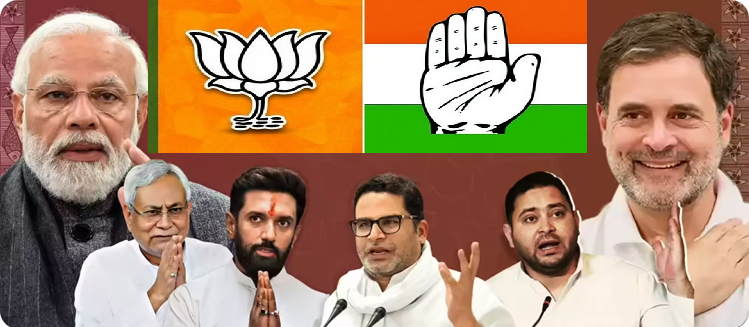
The state of Bihar has always held special significance in India’s political history. The recently concluded Bihar Legislative Assembly election has once again confirmed this historical fact. Defying predictions, the Bharatiya Janata Party (BJP) and its alliance have secured a massive majority. This outcome is more than just a regional electoral victory; it signals the direction and structure of national politics. Based on the analyses provided earlier, it is essential to delve deeper into the key reasons for this victory and its potential consequences.
Reasons for Victory
Invincible Political Organization and Strategy
The BJP’s greatest strength is its well-organized structure and scientific electoral strategy. A coordinated campaign at the central and state levels, data-driven voter outreach, and coalition-building among social groups (social engineering) have played a crucial role in the party’s victory. The same strategy appears to have been successfully employed in Bihar. Leveraging its organizational strength, the BJP successfully reached voters in every village. Its ‘poll booth’-centric strategy, with dedicated workers stationed at each booth, and its method of working based on in-depth analysis of voter lists, ensured this victory.
The Impact of Prime Minister Narendra Modi’s ‘Persona’
Modi remains the biggest attraction for the BJP. His image as the ‘Development Man’, the perception of his strong leadership, and his direct and forceful oratory style attract voters almost ‘god-like’. His presence at election rallies provided party candidates with the opportunity to campaign under ‘Modi’s umbrella’. Modi’s image has had a deep impact even in the rural areas of Bihar. His development promises, his tough stance on national security, and his efforts to elevate the country’s status on the international stage have influenced ordinary voters. Even his decisions (like demonetization) that caused hardship to the people, voters have been ready to forgive him.
Effective Presentation of ‘Cultural Nationalism’ Over Secularism
The BJP presents ‘Hindutva’ not just as a religious movement but more as a form of cultural nationalism. Issues like the construction of the Ram Temple and the Citizenship Amendment Act (CAA) have ignited feelings of enthusiasm and pride among its core supporters. Consequently, a large section of the populace seems to prioritize cultural identity over socio-economic issues (like unemployment, inflation). In a state like Bihar, where social equations are extremely complex, the agenda of cultural nationalism has worked to unite various castes. This is a factor that has attracted even communities traditionally opposed to the BJP.
Weak and Fragmented Opposition
Opposition parties, particularly the Congress, have failed to present a united and effective alternative. They lack the financial resources, united leadership, and a charismatic personality to counter Narendra Modi. In Bihar too, the opposition alliance seems to have fallen behind due to internal differences and strategic weaknesses. The opposition failed to effectively raise issues concerning the real problems of the people, such as unemployment, farmers’ issues, and women’s safety. Their criticism remained limited to anti-BJP sentiment, which failed to attract voters.
Limited but Effective Promotion of Government Schemes
The BJP has skillfully leveraged the benefits of central schemes like Ujjwala Yojana (gas connections), Pradhan Mantri Awas Yojana (housing), and the free food grain scheme for political gains. The direct benefits of these schemes have increased allegiance towards the party among targeted groups. In a poor state like Bihar, these schemes have directly brought positive changes to the standard of living. The link between the benefits of the schemes and political propaganda makes beneficiaries feel grateful to the BJP, leading them to tend to support the party at the time of voting.
The Role of Media and Communal Sentiments
Some media channels promoted communal (anti-Muslim) sentiments. The perception was spread that the Modi government has given a “voice” to Hindu voters and is “putting the Mughals in their place.” Communalism (saffron ideology) was made respectable in the name of nationalism (rashtrawad). This led to increased communal polarization, the benefit of which is seen to have accrued to the BJP in the ballot.
Consequences of the Victory
Further Strengthening of Hindutva Politics
The victory in Bihar will give the BJP-RSS more confidence. This will likely make their Hindutva agenda, such as the Uniform Civil Code (UCC) and interest in disputed sites in Mathura and Kashi, more active. This could pose a major challenge to the country’s secular framework. The politics of Hindutva could lead to increased communal tension in the country, heightened feelings of insecurity among minorities, and the weakening of the value of secularism.
Strengthening of the BJP’s Position in the Central Government
A regional victory provides stability to the central government as well. Increased support from MPs makes it easier to pass laws in Parliament, making it smoother to implement the BJP’s economic and social policies. The formation of a BJP-supported government in Bihar is a major relief for the central government. This will also strengthen the BJP’s position in the Rajya Sabha, making even constitutional amendments easier.
Atmosphere of Fear and Insecurity Among Minorities
The growing influence of the BJP and RSS will increase feelings of insecurity among the country’s minority communities, especially the Muslim community. The fear of hate crimes, lynching, and ‘bulldozer justice’ seems likely to persist. With the BJP coming to power in Bihar, minority communities may feel even more vulnerable. Issues like citizenship laws and the NRC pose the risk of permanently making them second-class citizens.
Continuity in Economic Policies
If one overlooks the criticism of ‘Corporate-Hindutva’, the BJP’s victory signals continuity in market-friendly policies, privatization, and policies supporting large industrial groups. While this may boost economic growth, the problems of employment and income inequality are likely to persist. In a backward state like Bihar, this could increase the pace of economic development, but significant change in the condition of small farmers and small entrepreneurs is less likely.
Psychological Advantage for the 2024 Lok Sabha Elections
The victory in a complex and politically crucial state like Bihar has given the BJP and the NDA alliance a significant psychological advantage for the 2024 general elections. This has dealt a severe blow to the opposition unity (INDIA alliance). Opposition parties now need to rethink their strategy. For the BJP, this electoral success is a new step that could help them form the government at the center once again.
Change in the Politics of Dalits and Tribals
The BJP has also been trying to increase its influence among Dalit and Tribal communities. This strategy seems partially successful in Bihar. This could lead to changes in traditional Dalit politics. A large segment of Dalits is now attracted to the BJP, which could change the very nature of Dalit politics in the future.
Changes in Education and Culture
The BJP’s victory will likely increase the influence of Hindutva ideology in the fields of education policy and culture. The rewriting of history, the Hinduization of culture, and the increased entry of Hindutva ideology into educational institutions could increase. This could lead to major changes in the country’s intellectual and cultural landscape.
Conclusion
The victory in Bihar is not just a significant political win for the BJP; it is also an indicator of the acceptance of its ideology and policies across the country. It shows that in Indian politics, victory can be achieved by prioritizing sentiments of religion, culture, and nationalism over economic issues. This victory will prove decisive for the future democratic, secular, and socio-economic character of India.
This victory of the BJP is pulling Indian democracy in two opposite directions. On one hand, it is proof of the popularity and power of the ruling party, while on the other hand, it also poses a serious threat to the country’s secular and pluralistic structure. The direction India takes in the future is being decided now. The Bihar election results have provided a glimpse into India’s political future, which needs to be analyzed seriously.